

Designing Savior Babies
on using IVF to create a sibling match for a dying child

This article was originally published for WORLD Magazine.
Duke’s twin basketball stars, Cameron and Cayden Boozer, would not exist if their older brother Carmani hadn’t been dying from sickle cell disease. When Carmani’s parents found out they could save his life with stem cells from a sibling’s umbilical cord, they decided to use IVF to select a perfect match. In a feat of modern science, the twins’ stem cells worked and doctors were able to perform a bone marrow transplant on Carmani, saving his life. “They were only born because I was sick. … They saved my life,” Carmani Boozer said.
But while this success story resulted in the lives of three young men, it also destroyed the lives of at least eight others. Eight sickle-free embryos were left over after the twins were selected and perhaps more with sickle-cell were discarded. Astoundingly, around 1.5 million human embryos live in cryostorage in the United States, and mounting concerns about storage space and cost continue to fester.
The lives of those created by IVF are as precious and as dignified as those conceived naturally. And Christians believe that all human life is sacred and imbued by God with dignity—including those embryos that are deemed unviable or unfit by modern science, which is itself fallible.
The Boozer Twins were born in 2007, but the technology that enabled their parents to select them 20 years ago has only become more advanced and mainstream. A host of venture-capital backed fertility startups are promising to help couples have their “best baby.” But really, they’re just practicing a new kind of eugenics: one in which children are ranked and selected (or discarded) based on their assigned genetic score.
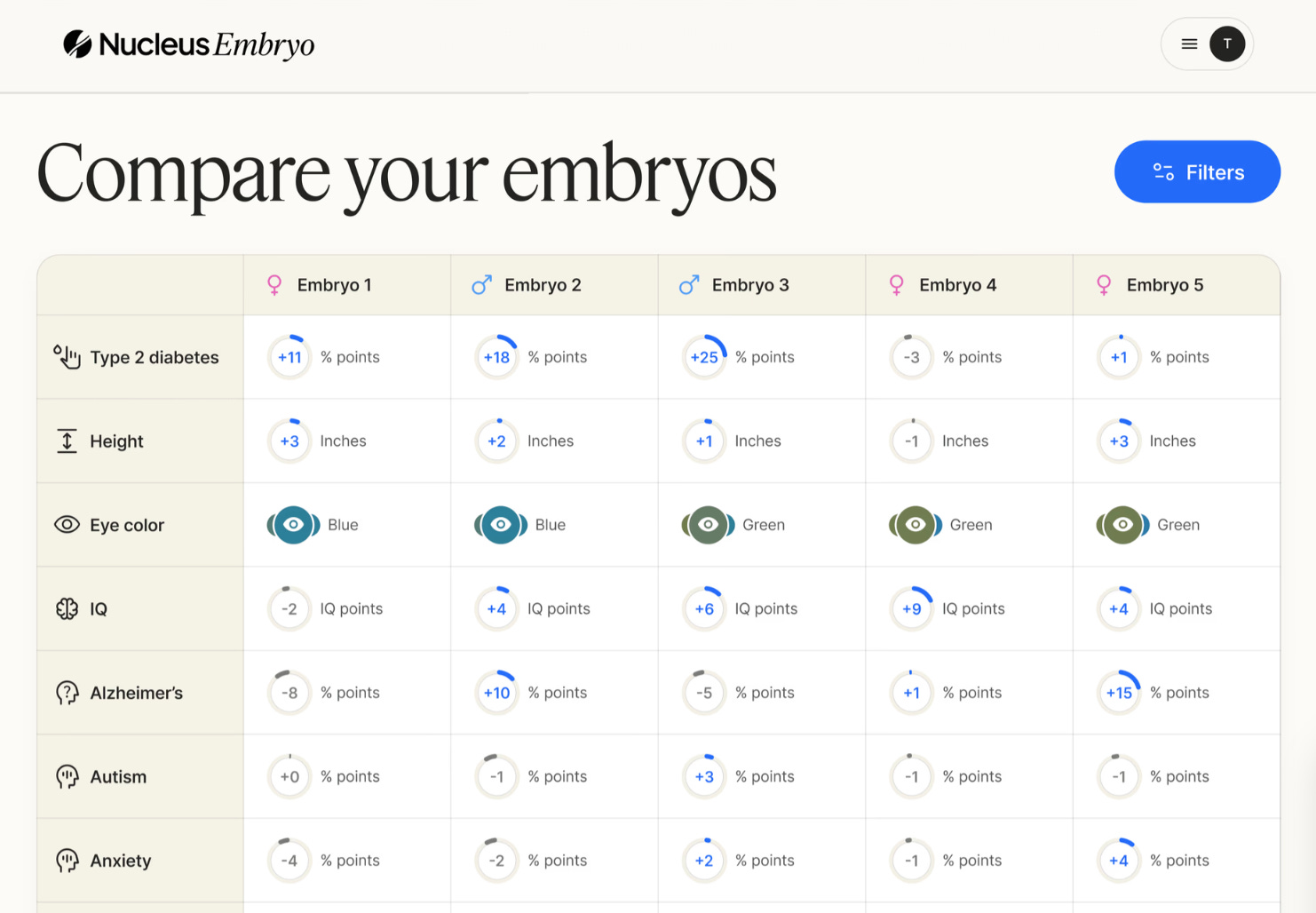
Companies like Orchid Bioscience or Nucleus Genomics or Genomic Prediction use a new AI-powered technology to sequence an embryo’s entire genome—sometimes using only a single cell—to generate what’s called a polygenic risk score. This risk score doesn’t tell you whether the embryo will have diabetes or cancer or a stellar IQ, but it predicts what is claimed to be the likelihood of the embryo developing these things sometime during his or her life. Plus, selections can be made for height or hair color or even sex (despite the fact that human sex-selection is condemned as a human rights violation by the United Nations, a rare feat of moral clarity for that organization).
The whole business model, of course, is based upon the creation of scores of excess embryos, so they can be ranked and sorted and chosen for the “best” characteristics. The risk scores are tallied up and sent home to parents much like a kindergarten report card. But most of the embryos that are screened will never get the chance to see a kindergarten classroom, or even take their first breath.
When parents become designers rather than stewards, our orientation toward our children radically changes.
If Orchid Bioscience founder Noor Siddiqui hopes for a future where most parents choose to buy her product to procreate, I’m concerned about a future where parents are coerced into using it. Already, couples with disabled children report being pressured to consider IVF to screen out future embryos with genetic conditions.
But when parents become designers rather than stewards, our orientation toward our children radically changes. We no longer see children as a God-given gift but as one choice among many, or as a means to the end of our own desires. In a documentary about the twins, Cece Boozer said, “You feel like you’re having a baby for the wrong reason. … I just felt guilty because it was more out of love for Carmani. It wasn’t out of love for them.”
Meanwhile, pastors report feeling unequipped to counsel their flock on issues surrounding IVF. One pastor reached out to me for advice on how to counsel a couple like the Boozers whose doctors were recommending IVF. The mother had a rare and painful genetic condition and a one-in-four chance of passing it down to her future children. “They want to know whether it’s okay to select embryos so their children don’t have the condition she suffers from,” the pastor told me.
It’s a heart-wrenching scenario. No parents want their child to suffer. The only problem is, parents aren’t screening conditions out of their children, as these companies deceptively advertise. They’re screening out their children. And Christians have long been known as the ones who rescue even deformed or disabled children from the cliffsides in recognition that all human life is a gift that is worthy of love and care. We should see the human embryo as worthy of that same kind of protection. After all, Jesus Christ Himself, the incarnate God, once existed as a human embryo.
With one in six couples facing infertility worldwide, stories like the Boozers’ are only the first of many about reproductive tech’s impact on our children, families, and humanity more broadly. But when pastors don’t know how to counsel their members on these technologies, the primary conscience-shapers become their doctors, and the cathedral collapses into the exam room. It’s time for that to change.
Thank you for reading Technically Human, a yearlong series of interviews and published work on reprotech, the moral limits of emerging reproductive technologies, and what it means to be human. Follow along here on Substack or on X at @annakateshelt, and please consider sharing.
Have you used prenatal genetic testing for embryos or pregnancies? Why or why not?Have you received a prenatal diagnosis, or been pressured to abort? Would you use an embryo screening test to screen for genetic diseases or traits in your children? Share in the comments, or message me directly for a chance to be featured on Technically Human.
This project is made possible by The Fund for American Studies’ Robert Novak Journalism Fellowship.
An important point that this is screening out children, not conditions. It's usually advertised as the reverse.
IVF reminds me of the Greek myth about Pandora's box. In that, it is similar to nuclear power, AI and even many life saving medical advances. We have created powers that exceed what we have the firm grip on morality to wield well. Yes, they produce amazing goods, but at such costs that we all too often turn a blind eye to.