

Introducing: Technically Human
Tech is reinventing reproduction. Will we let it?


Nothing is as fundamental to the human experience as birth. But Silicon Valley and other investors are hoping to change that, to “reinvent reproduction.” And I have questions.
I’m Katelyn Shelton, and I’m a Robert Novak Journalism Fellow and Visiting Fellow at the Ethics and Public Policy Center in Washington, D.C. where I research and write on issues of bioethics. Today I’m launching Technically Human on Substack, a yearlong investigation into emerging reproductive technologies and how they’re changing what it means to be human.
What does it mean to be human? If we change something as fundamental as how we reproduce, how might that change humanity? Will pregnancy robots eventually supplant mothers gestating their own children? Will embryo selection – micromanaging our children down to their very DNA – affect the way we view them? Change the way we treat them? Or even… change the way they feel about us?
“Have your best baby,” the ads proclaimed in the New York City metro, just a matter of weeks ago. The ads featured a number of plump and beautiful babies, next to a QR code and a caption: “These babies have great genes.”
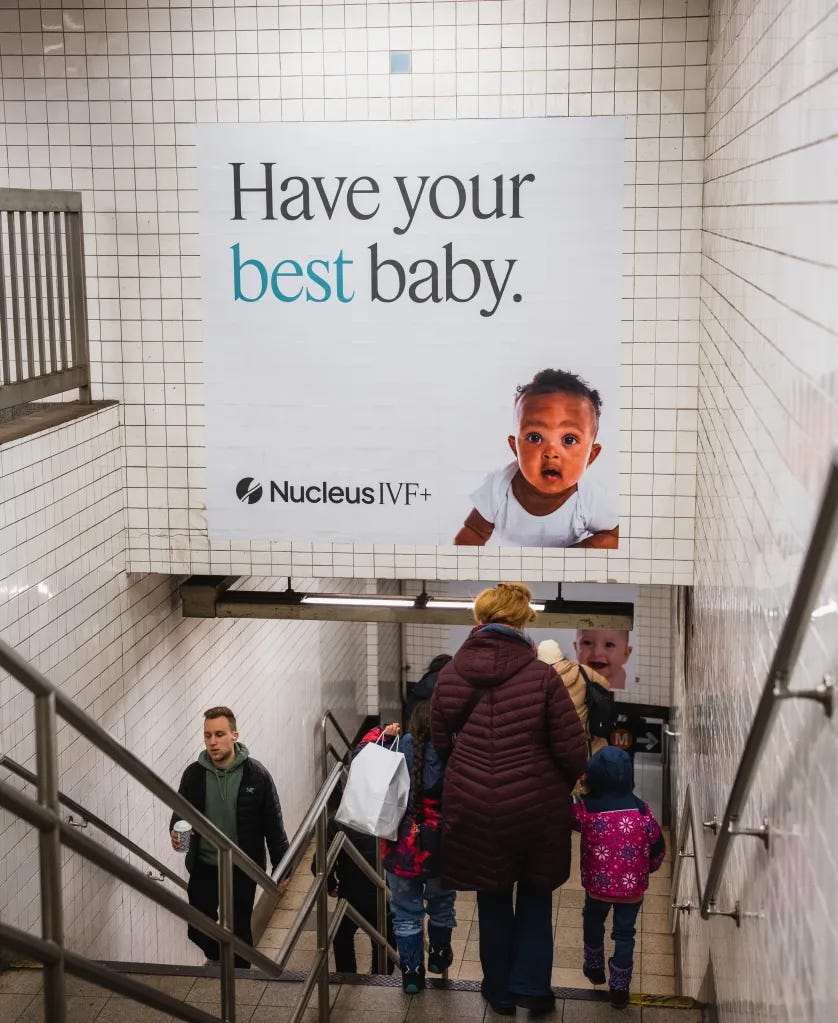
The controversial ad campaign was launched by Nucleus Genomics, one of a host of new venture-capital backed, fertility-focused startups in the United States.
Companies like Nucleus or Orchid or Genomic Predictions use a new technology to screen an IVF-created embryo for diseases and traits like sex, height, eye color, and even IQ. Each embryo is assigned a grade and a report, their future health determined and sent home like a kindergarten report card.
But in this case, parents aren’t evaluating their child’s learning performance. They’re evaluating their child’s genes, and ranking them against all their siblings. For the first time in history, we are deciding who gets to exist based on predicted performance.
Emerging technology selects, edits, stores, discards, or redesigns this life in a petri dish, and there are few laws governing what happens under the fluorescent lights of the lab.
You’ll often hear that the United States is the “wild west” of the women’s health and fertility landscape. We are the fertility tourism capital of the world: people travel from all over the globe to do here what they could do nowhere else. Not because the technology is so much better here: but because the absence of laws and taboos are so much worse.
Unlike most developed nations, the US has no overarching federal law governing the creation, manipulation, freezing, sale, or destruction of human embryos. The fertility industry is largely market-driven and self-regulated, worth more than $8B annually and on track to make a lot more than that.
There are no national standards like how many eggs can be harvested at a time, how many embryos can be created or transferred, or how the embryos should be treated, stored, or disposed of. Depending on where you are, embryos are either treated legally as property, potential life, or persons.
If you have the good fortune of being a certain kind of embryo, however, there are multiple layers of regulation, at the federal, state, and industry-standard levels. The treatment, transfer, sale, and transport of equine embryos, that is, horses, are more strictly regulated than that of human embryos manipulated in a fertility clinic.
It is clear that reproductive technology has outpaced our moral imagination: We cannot regulate what we cannot rightly condemn.
Right now, we are on the cusp of many momentous biotechnical advances, some of which hold great promise – and some of which hold great propensity for harm — for babies, for women, for families, and for our nation.
While companies like Nucleus predict and rank an embryo’s DNA, CRISPR can be used to actually edit it. While there are different types of gene editing, some of it potentially good, heritable gene editing involves manipulating an embryo’s DNA in a petri dish, meaning all changes, good or bad, are likely passed on to the next generation. And though there are international agreements amongst scientists that they won’t open that Pandora’s Box, one Chinese scientist already has.
He Jiankui shocked the world when he announced that he had edited the DNA of a set of Chinese twin girls in 2018. The full effects on those girls are still unknown, but at least one of them suffers from a mistake Jiankui made – and any genetic errors made by the scientist could be passed on for generations.
He Jiankui was sentenced to three years in prison by Chinese authorities, perhaps to maintain appearances with the international community and its self-imposed rules. But now Jiankui is back at work, and last year he announced the new location of his independent lab: Austin, Texas.
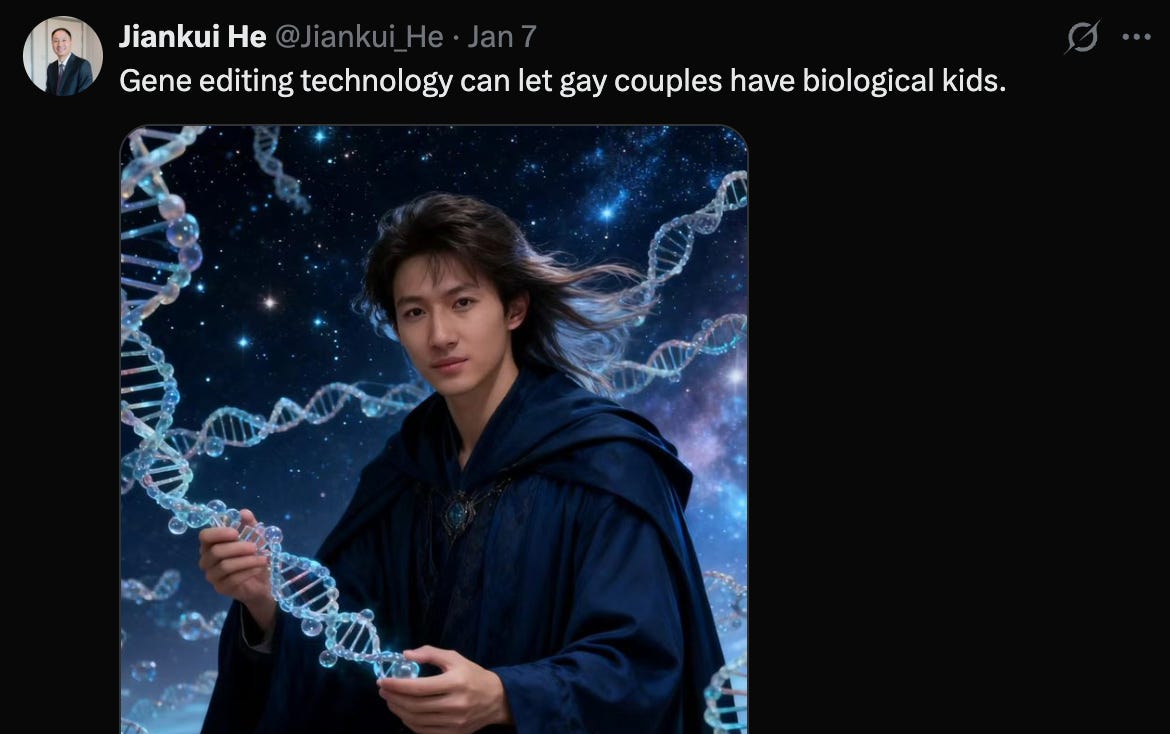
While Jiankui promotes his work as curing genetic diseases, there is no guarantee that people would not use the technology to make edits beyond curative ones, in an attempt to influence traits, like height or skin color or IQ. How could we believe that they wouldn’t, when companies like Nucleus already allow parents to choose such traits in their embryos?
When companies are already making money practicing eugenics, there’s no reason we should trust scientists not to try it another way.
For centuries, modern medicine has sought to overcome disease. Now it seeks to overcome biology. Some fear we are witnessing the technological erasure of human nature. But not all applications of cutting-edge reproductive technologies are so dystopian.
Consider, for example, Nicole Muldoon, who was told her son would be born with a fatal genetic condition. She didn’t expect him to live more than a few weeks. But thanks to a new gene-editing technology tailored specifically to her baby, doctors were able to cure baby KJ of his genetic condition. A few days after his birth, his parents expected to have a funeral – but now they’re celebrating his birthdays.
Technology isn’t inherently bad. How we use it can be.
Few issues hold greater significance for the future of the human race. That’s why I’ll be interviewing doctors, ethicists, geneticists, and the women who have either used these technologies or refused them, asking both what science can do for us, and what science may do to us. And what we should do about it.
Follow along here at Technically Human or on X at @annakateshelt, where I’ll share written interviews as well as links to my published work exploring the moral limits of reproductive biotechnologies.
Finally, do you have a story about reprotech and what it means to be human, or know someone who does? Have you been affected by IVF, surrogacy, abortion, genetic screening, women’s healthcare, disability in pregnancy, or something else? Please be in touch, either in the comments or DM, as I’d love to share your story (anonymously, if desired). Thank you for reading.
I have 2 kids with an inherited genetic syndrome that causes profound hearing loss, progressive vision loss, and balance impairment (Usher Syndrome.) We met with a genetic counselor as part of their diagnosis and one of the things offered to us was if we wanted to have more children they could create embryos and test them and then we could discard the “unhealthy” embryos. They said this while my daughters were in the room. We said no thanks and went on to have 2 more children (we have 5 total) who ended up not having Usher syndrome. They could be carriers but we have not had carrier testing done for them. I would 💯 sign on to CRISPR editing to cure my girls. It’s devastating to watch your children go blind. However, never in a million years would I say that it would be better if they weren’t here at all. We go to medical conferences hoping for cures, staying updated on research, and praying that the treatments we can avail ourselves of will be ethical and uphold the dignity of our kids.
Very much looking forward to this series. These topics are both fascinating and frightening and so deserving of critical, smart assessment and investigation.
My brush with these industries was one I didn’t follow through with thankfully, but I came pretty close to donating eggs when I was 19. I was a heroin addict at the time and only chose to pursue “donation” for the money but backed out because I knew what I was doing was wrong on my end and theirs. The woman who I had been working with actually was charged at the federal level for defrauding the women who did go through with it, as she didn’t pay them.
I wrote about it at the below link, I have it paywalled but am happy to comp you if you are interested! I wanted to highlight the desperation many women are experiencing that influences these choices. Just let me know if you need a comp.
https://open.substack.com/pub/theworkofwomen/p/that-one-time-i-almost-donated-my?r=1ljam1&utm_medium=ios